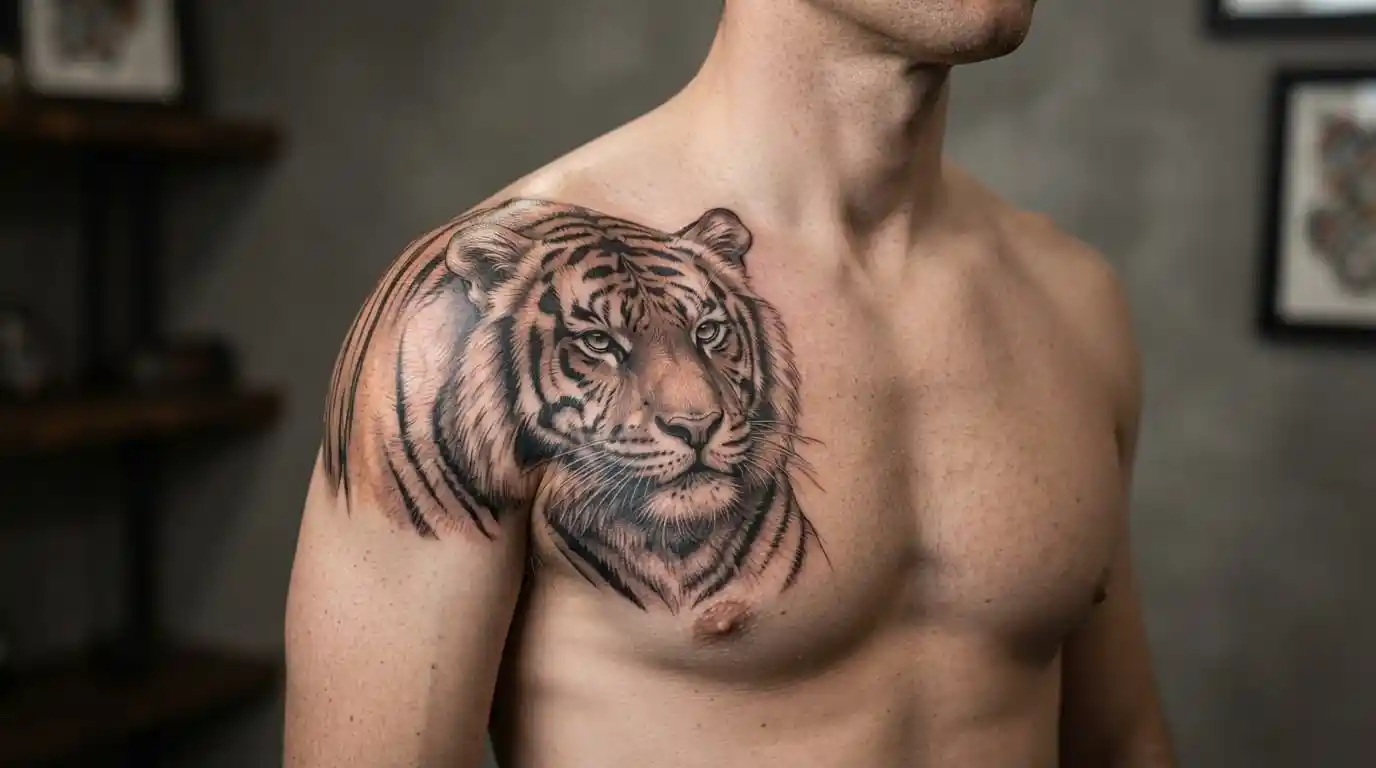
A tiger tattoo commonly represents strength, courage, independence, protection, resilience, and personal power. But the meaning can change significantly depending on the tiger’s expression, pose, cultural tradition, artistic style, and the story behind the tattoo.
A roaring tiger may suggest defiance or fearlessness. A calm tiger can communicate controlled strength and confidence. A tiger with cubs may emphasize protection and family, while a tiger-and-dragon composition can introduce ideas about opposing or complementary forces.
The important thing is that there is no single universal definition of a tiger tattoo.
The symbolism comes from several places: the tiger’s real behavior and physical presence, historical and cultural traditions, modern tattoo conventions, and the wearer’s personal interpretation.
What Does a Tiger Tattoo Mean?
The most common tiger tattoo meanings include:
- Strength
- Courage
- Power
- Protection
- Independence
- Resilience
- Confidence
- Determination
- Focus
- Personal freedom
- Controlled aggression
- Survival
These meanings are common interpretations rather than fixed rules.
The tiger’s physical power naturally makes it a symbol of strength. Its solitary hunting behavior can also inspire ideas of independence and self-reliance. Its ability to defend territory and cubs can contribute to interpretations involving protection.
But a tattoo can emphasize one quality over another.
For example, a snarling tiger may communicate confrontation, while a resting tiger can suggest calm authority. A tiger protecting cubs can shift the focus from personal power to family.
So, when asking “What does a tiger tattoo mean?”, the better question is often:
What kind of strength does this tiger represent?
Why Is the Tiger Associated With Strength and Courage?
Some tiger symbolism comes directly from the animal itself.
Tigers are large predators with powerful bodies, strong jaws, sharp claws, and an ability to move through their environment with considerable stealth. Their physical presence makes strength and danger natural human associations.
Their behavior also contributes to the symbolism.
A tiger is generally a solitary hunter rather than a social pack hunter. That characteristic can inspire modern interpretations involving independence, self-reliance, and confidence.
None of this means that every tiger tattoo represents independence or courage. It explains why those ideas are repeatedly associated with the animal.
This distinction is important because modern tattoo symbolism often develops from a combination of observation and cultural storytelling.
Tiger Symbolism in Chinese Culture
Tiger symbolism has a long and well-documented history in Chinese art and culture.
The Metropolitan Museum of Art describes the tiger as the king of wild animals and notes its associations with bravery, swiftness, and protection against harmful spirits. Tigers also appear as one of the twelve Chinese zodiac animals.
The National Museum of China also connects the tiger with strength, courage, majesty, vitality, and the ability to oppose evil.
This creates an important historical foundation for modern interpretations of tiger imagery.
In a Chinese-inspired tattoo, a tiger may therefore carry meanings involving:
- Courage
- Strength
- Authority
- Protection
- Vitality
- Bravery
- Auspiciousness
The White Tiger in Chinese Symbolism
The white tiger has a more specific cultural meaning than simply “a tiger colored white.”
In Chinese cosmology, the White Tiger is one of the Four Symbols associated with the cardinal directions. The Metropolitan Museum identifies the White Tiger with the west, alongside the Azure Dragon of the east, Vermilion Bird of the south, and Black Tortoise of the north.
Because of this, someone intentionally designing a White Tiger as a reference to this tradition is making a more specific cultural statement than someone who simply likes the appearance of a white tiger.
That distinction is worth keeping in mind when choosing a design.
Japanese Tiger Tattoo Meaning
Japanese tiger tattoos are among the most recognizable tiger designs in tattoo culture.
In Japanese art, tiger imagery developed through centuries of cultural exchange with China and Korea. The Tokyo National Museum notes that tigers were favored by the warrior class as subjects for paintings and sword fittings and describes them in terms of courage, power, virtue, affection, and protection.
This gives the traditional Japanese tiger a richer background than simply “a fierce animal.”
A Japanese tiger tattoo may be interpreted through themes such as:
- Courage
- Physical strength
- Protection
- Determination
- Controlled power
- Bravery
- Guardianship
The visual language matters too. Traditional Japanese tattoo compositions often use the tiger as part of a larger scene rather than treating it as an isolated animal portrait.
Korean Tiger Symbolism
Korean tiger imagery offers another useful reminder that tiger symbolism is not identical across East Asia.
The National Museum of Korea documents tigers as protective figures in Korean art and notes that tiger paintings were sometimes used to ward off evil spirits. Korean folk art could also portray the tiger in humorous or approachable ways rather than presenting it only as a terrifying predator.
The Asian Art Museum describes the Korean tiger-and-magpie tradition, known as jakhodo. In these works, the tiger could represent protection while the magpie was associated with good news. Some later examples also carried social and political meaning.
This is a good example of why broad statements such as “Asian cultures believe tigers mean strength” are too simple.
Different traditions developed different visual languages around the same animal.
Tiger Tattoo Meaning in Spiritual and Religious Contexts
Tiger imagery can also appear in religious or spiritual art, but the meaning depends on the specific tradition.
In Korean Buddhist and folk contexts, for example, museum collections document the tiger alongside the Mountain Spirit. The tiger could function as a sacred mountain animal within this visual tradition.
In Japanese Buddhist and Zen-related art, tiger and dragon imagery also developed within a larger tradition of representing powerful natural forces. The Metropolitan Museum documents a Japanese painting in which dragon and tiger appear as powerful beings associated with older Chinese and Japanese Zen imagery.
This does not mean every Japanese-style tiger tattoo is religious.
A person may choose the style purely because they appreciate traditional Japanese tattoo art.
The cultural reference and the personal meaning can coexist, but they should not automatically be treated as the same thing.
What Does a Tiger Tattoo Mean Today?
Modern tiger tattoos often combine traditional symbolism with personal experiences.
Someone might choose a tiger to represent:
- Getting through a difficult period
- Becoming more confident
- Protecting family
- Setting stronger boundaries
- Becoming independent
- Surviving adversity
- Taking control of their life
- Developing discipline
- Embracing their wild side
- Simply admiring tigers
The tattoo does not need a historical explanation to be meaningful.
A person can choose a tiger because it is their favorite animal.
That is a valid meaning.
Modern tattoo culture increasingly allows traditional symbolism and personal storytelling to overlap rather than requiring the wearer to follow a fixed symbolic system.
Tiger Tattoo Meaning by Pose
The pose may be one of the most important design decisions because it changes the emotional tone of the tattoo.
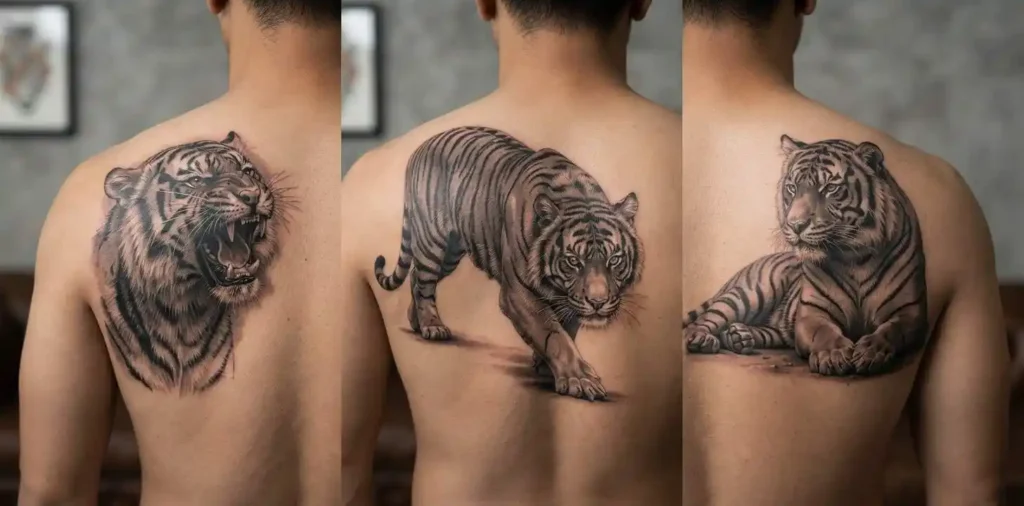
Roaring Tiger Tattoo
A roaring tiger commonly suggests:
- Defiance
- Fearlessness
- Warning
- Courage
- Confrontation
- Activated strength
- Protection
An open mouth and visible teeth make the design feel more aggressive.
But a roar does not necessarily mean violence.
It can represent finding your voice, defending yourself, overcoming fear, or refusing to be intimidated.
Stalking Tiger Tattoo
A stalking or prowling tiger can suggest:
- Focus
- Patience
- Strategy
- Determination
- Self-control
- Readiness
- Controlled power
This design emphasizes the tiger’s ability to wait rather than immediately attack.
For someone who wants a tiger tattoo to represent discipline rather than aggression, a stalking pose may communicate that idea more effectively.
Resting Tiger Tattoo
A resting tiger can symbolize:
- Calm strength
- Confidence
- Patience
- Self-control
- Peace
- Power held in reserve
A relaxed tiger can actually make a strong statement because the animal does not need to demonstrate its power constantly.
Tiger Head Tattoo
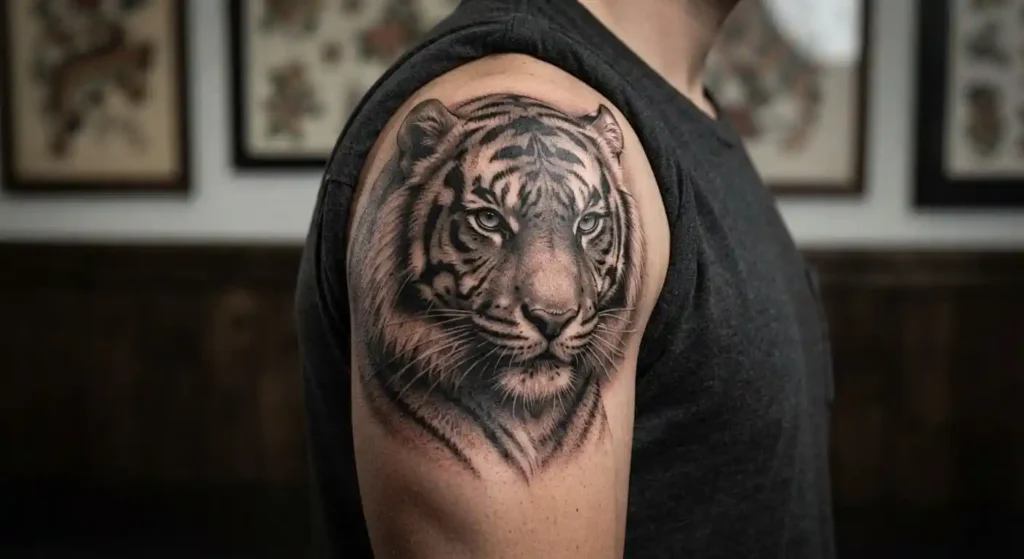
A tiger head focuses attention on the face, eyes, stripes, and expression.
It may emphasize:
- Personal strength
- Focus
- Confidence
- Intensity
- Vigilance
- Identity
The eyes can dramatically affect the emotional tone.
A direct stare can feel challenging or protective, while softer eyes can make the design feel calmer.
Full-Body Tiger Tattoo
A full-body tiger provides more room to communicate movement.
It can show:
- Walking
- Stalking
- Leaping
- Turning
- Climbing
- Resting
- Interacting with other symbols
Because the entire body is visible, the composition can tell more of a visual story.
Tiger Tattoo Meaning
Tiger symbolism is not inherently gender-specific.
A tiger tattoo can represent strength, independence, protection, confidence, or resilience regardless of whether the wearer is a man or woman.
Search behavior often separates tiger tattoos into “for women” and “for men,” but these searches usually reflect design preferences rather than fundamentally different symbolism.
For example, someone may prefer:
- Floral tiger → strength combined with softness or beauty
- Large realistic tiger → physical power and intensity
- Minimal tiger → subtle personal symbolism
- Roaring tiger → boldness or defiance
- Calm tiger → confidence and self-control
The important distinction is the design, not the gender of the person wearing it.
What Does a White Tiger Tattoo Mean?
A white tiger tattoo can have several possible interpretations.
In a modern tattoo context, a white tiger may suggest:
- Individuality
- Rarity
- Strength
- Mystery
- Distinctiveness
- Inner power
However, white color does not automatically make the tattoo a representation of the Chinese White Tiger.
If the design intentionally references Bai Hu or the related East Asian traditions, the symbolism becomes much more specific.
If someone simply wants a realistic white tiger because they like the animal, there is no need to assign a deeper mythological meaning.
What Does a Bengal Tiger Tattoo Mean?
A Bengal tiger tattoo can emphasize the real animal rather than a purely symbolic tiger.
It may represent:
- Wildness
- Strength
- Survival
- Respect for nature
- Admiration for wildlife
- Personal connection to the natural world
Species-specific tattoos can also be chosen for conservation reasons or simply because the wearer prefers the animal’s appearance.
This is one area where personal meaning can be more important than traditional symbolism.
What Does a Tiger and Dragon Tattoo Mean?
Tiger-and-dragon tattoos are particularly rich in East Asian visual traditions.
The Metropolitan Museum describes dragon-and-tiger pairings as symbols of complementary opposites, including yin and yang, male and female, east and west, and wind and water.
In modern tattoo interpretation, the pairing can suggest:
- Opposing forces
- Balance
- Strength and wisdom
- Instinct and intellect
- Earth and sky
- Conflict
- Complementary power
But the exact meaning depends on the composition.
Two creatures fighting may emphasize conflict.
Two creatures flowing around one another may suggest balance.
This is why the visual relationship matters more than simply adding “dragon” to a tiger tattoo.
Tiger and Flower Tattoo Meaning
Flowers can soften or redirect the visual message of a tiger.
A tiger with flowers may represent the combination of:
- Strength and beauty
- Power and gentleness
- Fierceness and peace
- Nature and resilience
- Masculine and feminine visual qualities
The specific flower can add another layer.
For example, a rose may introduce themes of love or beauty, while a peony is particularly common in East Asian-inspired tattoo compositions.
However, flowers do not have one universal meaning either.
The tattoo’s style and the wearer’s intention should be considered together.
Tiger and Cub Tattoo Meaning
A tiger with cubs strongly emphasizes family and protection.
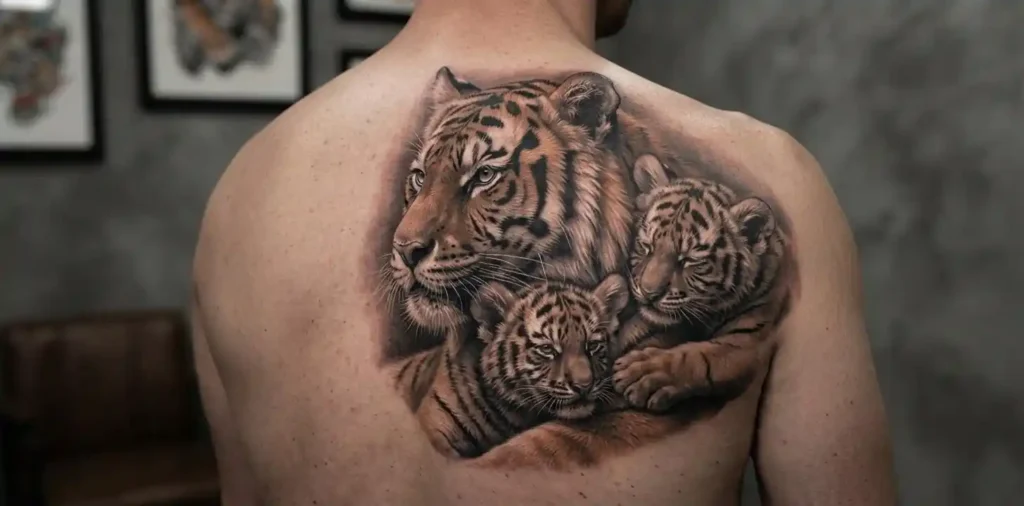
It can represent:
- Parenthood
- Family loyalty
- Protection
- Responsibility
- Nurturing strength
- Love for children
The tiger’s power is no longer the only focus.
Instead, the design shows what that power is being used to protect.
This can make a tiger-and-cub tattoo especially meaningful for parents or anyone whose identity is strongly connected to family.
Tiger Tattoo Color Meanings
Color can influence the mood of a tiger tattoo, but colors do not have universal tattoo meanings.
A few common visual interpretations include:
Orange tiger → emphasizes the animal’s natural appearance, warmth, energy, and traditional tiger imagery.
Black-and-gray tiger → can create a serious, dramatic, classic, or realistic appearance.
White tiger → may emphasize rarity, individuality, or a specific cultural reference.
Blue tiger → can create a cooler, more surreal, or artistic interpretation.
Red tiger → may visually intensify passion, energy, danger, or aggression.
These are design interpretations, not fixed symbolic rules.
If a color has a specific cultural meaning in a particular tattoo tradition, that context should take priority over a generic color chart.
Does Tiger Tattoo Placement Have a Meaning?
Tattoo placement does not have one universal symbolic language.
A tiger on the back does not automatically mean protection.
A tiger on the chest does not automatically mean courage.
A tiger on the arm does not automatically mean strength.
Placement can influence the tattoo in more practical ways:
- Visibility
- Available space
- Detail
- Movement
- Body contours
- Relationship with other tattoos
Large areas such as the back, chest, thigh, and upper arm can accommodate a full tiger and surrounding elements.
Smaller areas may work better with a tiger head, eye, paw, or simplified design.
The placement should support the composition rather than being chosen because an online symbolism chart assigns it a supposed universal meaning.
Popular Tiger Tattoo Styles and What They Can Communicate
Japanese-Style Tiger
A Japanese-style tiger can emphasize:
- Traditional symbolism
- Courage
- Protection
- Strength
- Movement
- Cultural appreciation
If the design intentionally references Japanese tattoo traditions, it is worth learning about the visual vocabulary rather than treating it as generic “Asian” artwork.
Realistic Tiger
A realistic tiger focuses attention on the actual animal.
It can communicate:
- Respect for wildlife
- Strength
- Beauty
- Intensity
- Personal admiration
This style works especially well when the animal itself is the primary subject.
American Traditional Tiger
American traditional tiger tattoos often use bold outlines, strong contrast, and simplified forms.
The visual style itself has a long history in American tattooing.
A traditional tiger can therefore communicate toughness, boldness, and classic tattoo aesthetics without needing a complex symbolic story.
Black-and-Gray Tiger
Black-and-gray designs can create a dramatic and timeless appearance.
They may emphasize:
- Seriousness
- Realism
- Strength
- Mystery
- Contrast
The meaning still comes primarily from the tiger and composition rather than the absence of color.
Minimalist Tiger
A minimalist tiger may be chosen when the wearer wants the symbolism without a large, highly detailed tattoo.
A simple outline or small tiger head can represent strength or independence while keeping the meaning relatively private.
Tiger Tattoo Meaning and Personal Stories
Traditional symbolism is only one layer.
A tiger can become a personal symbol for almost anything connected to strength or survival.
For example:
Recovery → the tiger represents strength during a difficult period.
Family → the tiger represents protection and responsibility.
Independence → the tiger represents creating your own path.
Confidence → the tiger represents learning to trust yourself.
Boundaries → the tiger represents defending what matters.
Transformation → the tiger represents becoming stronger after hardship.
Wildlife appreciation → the tiger represents admiration for nature.
There is no requirement that the tattoo match a historical symbolism dictionary.
Your personal story can be the most important meaning of all.
How to Choose a Tiger Tattoo Based on Meaning
Start with the sentence:
“My tiger represents…”
Finish it before choosing the design.
For example:
“My tiger represents protecting my family.”
That suggests a different composition from:
“My tiger represents independence.”
Or:
“My tiger represents surviving a difficult chapter of my life.”
Once the central idea is clear, choose design elements that support it.
If Your Main Meaning Is Strength
Consider:
- Strong facial expression
- Full-body tiger
- Bold contrast
- Powerful posture
- Large-scale composition
If Your Main Meaning Is Protection
Consider:
- Tiger with cubs
- Watchful expression
- Defensive posture
- Family-related elements
- Protective composition
If Your Main Meaning Is Independence
Consider:
- Solitary tiger
- Walking or prowling pose
- Open natural environment
- Minimal surrounding imagery
If Your Main Meaning Is Calm Strength
Consider:
- Resting tiger
- Closed mouth
- Relaxed posture
- Black-and-gray realism
- Minimal composition
If Your Main Meaning Is Cultural Connection
Choose the specific tradition first.
If the design is Japanese, Chinese, Korean, Thai, or another culturally specific tattoo tradition, research that tradition rather than combining symbols randomly from different cultures.
That approach produces a more respectful and coherent design.
Are Tiger Tattoos Considered Aggressive?
Not necessarily.
A tiger can look aggressive, but aggression is only one possible interpretation.
A roaring tiger with exposed teeth naturally creates a more confrontational impression.
A resting tiger can communicate calm authority.
A tiger with cubs can emphasize nurturing protection.
A stalking tiger can represent patience and controlled power.
So the expression and posture determine much of the emotional tone.
Can a Tiger Tattoo Represent Survival?
Yes.
Survival is a common modern personal interpretation of tiger imagery, particularly when the tattoo marks overcoming a difficult period.
The tiger’s physical strength and ability to survive as a wild predator make it an intuitive metaphor for resilience.
But this meaning is primarily a modern personal interpretation rather than a universal historical definition.
Someone who chooses a tiger after overcoming hardship may see it as a reminder:
“I survived, and I am stronger because of it.”
That personal statement can become more important than any traditional symbolism.
Common Mistakes When Choosing a Tiger Tattoo
Treating One Meaning as Universal
A tiger does not always mean aggression, masculinity, dominance, or courage.
Context matters.
Mixing Cultural Symbols Without Research
A Japanese tiger, Chinese White Tiger, Korean folk tiger, and Thai Sak Yant tiger belong to different traditions.
They should not automatically be treated as interchangeable.
Adding Too Many Symbols
A tiger, dragon, skull, moon, flowers, clock, compass, and quote may all look interesting individually.
Together, they can make the tattoo’s message unclear.
Choose a central idea first.
Making a Detailed Tiger Too Small
Tigers rely heavily on facial features and stripe patterns.
If the design is too small, those details may become difficult to preserve visually over time.
Ask your tattoo artist how much space is needed for the level of detail you want.
Frequently Asked Questions About Tiger Tattoo Meaning
What does a tiger tattoo symbolize?
A tiger tattoo commonly symbolizes strength, courage, independence, protection, resilience, confidence, and personal power. The exact interpretation depends on the design, cultural context, and personal meaning.
What does a tiger tattoo mean spiritually?
There is no single spiritual meaning for tiger tattoos. Specific traditions give tiger imagery different meanings. For example, Chinese, Japanese, Korean, and other traditions have their own histories of tiger symbolism, including protection, courage, auspiciousness, and sacred imagery.
What does a white tiger tattoo symbolize?
A white tiger may symbolize individuality, rarity, strength, or inner power in modern tattoo culture. If it intentionally represents the White Tiger of East Asian cosmology, it carries a much more specific cultural meaning connected with the west.
What does a tiger and dragon tattoo mean?
A tiger-and-dragon tattoo can represent opposing or complementary forces such as strength and wisdom, instinct and intellect, or earth and sky. In East Asian art, the pairing has documented associations with complementary opposites and yin-yang concepts.
What does a roaring tiger tattoo mean?
A roaring tiger commonly suggests courage, defiance, warning, fearlessness, or activated strength. It can also represent finding your voice or defending personal boundaries.
What does a tiger tattoo mean for women?
Tiger symbolism does not fundamentally change by gender. A woman may choose a tiger to represent strength, independence, protection, confidence, resilience, or personal identity, just as anyone else can.
What does a tiger tattoo mean for men?
A tiger tattoo can represent strength, courage, independence, discipline, protection, or confidence. These meanings are not exclusive to men.
Can a tiger tattoo represent family?
Yes. A tiger with cubs is a particularly clear way to emphasize family, protection, parenthood, responsibility, and nurturing strength.
Conclusion
The tiger tattoo meaning usually begins with strength, courage, power, independence, protection, and resilience.
But the deeper meaning depends on the story behind the design.
A roaring tiger can communicate defiance. A stalking tiger can suggest focus and patience. A resting tiger can represent controlled strength. A tiger with cubs can shift the focus toward family and protection.
Culture adds another layer.
Chinese traditions give the tiger documented associations with bravery, protection, vitality, and the zodiac. Japanese art developed its own tiger imagery through centuries of cultural exchange, while Korean traditions include protective, spiritual, and even humorous representations of the animal.
Modern tattooing adds another layer again.
The same tiger can represent survival for one person, family for another, independence for someone else, or simply admiration for the animal.
That is why the most meaningful tiger tattoo is not necessarily the one with the most symbolism.
It is the one where the animal, design, cultural context, and personal story work together.

The meanings behind tattoo imagery are a central focus for writer Rachel Turner, who brings 5 years of experience to the subject. Her work explores symbolism in animals, flowers, plants, symbols, and celestial designs, while she compares motif interpretations, checks contextual details, and refines explanations for precise, well-structured tattoo meaning guides.